
Tag: #AY2025_26

  • Understanding the Second National Judicial Pay Commission (SNJPC) and the Ongoing Deliberations on TDS Applicability

    Understanding the Second National Judicial Pay Commission (SNJPC) and the Ongoing Deliberations on TDS Applicability

    The Second National Judicial Pay Commission (SNJPC) was established in 2017 by the Supreme Court of India to assess and recommend changes to the pay scale and service conditions of district judiciary officers across the nation. Headed by former Supreme Court Judge Justice P.V. Reddy, with former Kerala High Court Judge R. Basant as a member, the commission aimed to ensure a fair and equitable remuneration structure for judicial officers. The primary goal was to rectify long-standing disparities in their compensation and improve the financial welfare of the judiciary at the district level, recognizing the pivotal role these officers play in ensuring justice is administered at the grassroots level.

    In June 2022, the Supreme Court ordered the implementation of the revised pay scale proposed by the SNJPC, effective from January 1, 2016. A bench consisting of Chief Justice N.V. Ramana, Justices Krishna Murari, and Hima Kohli also directed that the arrears owed to judicial officers be paid in three installments: 25% within three months, another 25% in the following three months, and the remaining balance by June 30, 2023. In response to concerns regarding compliance, revised directions were issued in May 2023 to ensure that the Court’s mandate was fulfilled, further emphasizing the commitment to improving the conditions of judicial officers.

    Currently, a key issue under deliberation before the Supreme Court is the applicability of Tax Deduction at Source (TDS) on the allowances provided to judicial officers under the SNJPC recommendations. This issue, which is sub judice, forms part of the ongoing proceedings in the All India Judges Association case. The case seeks to clarify whether the allowances granted to judicial officers, intended to enhance their financial and professional conditions, should be subject to TDS as per the provisions outlined in the Income-tax Act, 1961.

    On July 15, 2024, during a hearing on the matter, the Court underscored the importance of resolving this question of taxability. Mr. N. Venkataraman, the Additional Solicitor General, informed the bench that the issue would be reviewed by the Revenue Department of the Ministry of Finance. The Court subsequently adjourned further deliberations to August 5, 2024, to allow the Ministry time to provide its findings. Given the sub judice status of the matter, its resolution is expected to have significant ramifications not only for the financial obligations of judicial officers but also for the broader administrative processes involving the judiciary and government.

    In the meantime, the Central Board of Direct Taxes (CBDT) under the Ministry of Finance issued revised comments regarding the exemptions from TDS for allowances paid to judicial officers under the SNJPC recommendations. This was formalized through an Office Memorandum (F. No. 275/67/2024-IT(B)), dated August 6, 2024. The memorandum provides insights into the taxability of various allowances granted to judicial officers under both the Old and New Tax Regimes, as governed by the provisions of the Income-tax Act, 1961 and the Income-tax Rules, 1962.

    The memorandum is a vital resource for understanding which allowances are exempt from taxation and which may be subject to TDS. For clarity, the CBDT issued a comprehensive table outlining the taxability of allowances under both tax regimes. However, since the matter remains sub judice before the Hon’ble Supreme Court, the final determination regarding the exemptions from TDS on allowances paid to judicial officers will only be settled upon an authoritative ruling by the Court.
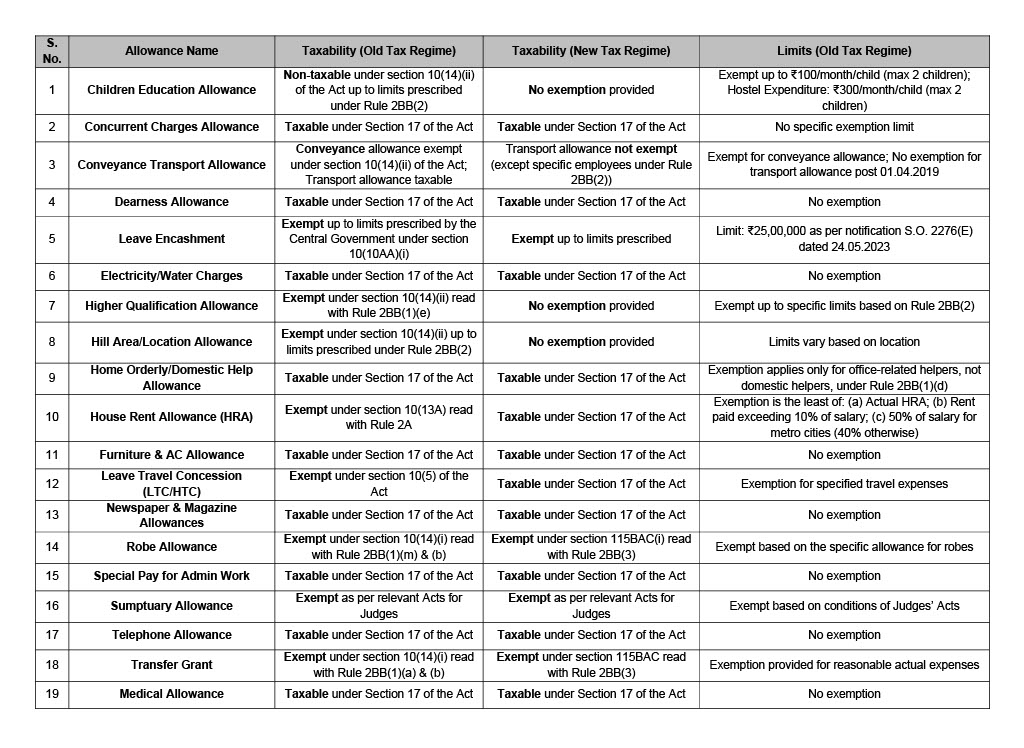
    F. No. 275/67/2024-IT(B)
    Revised Comments issued by CBDT vide Office Memorandum (F. No. 275/67/2024-IT(B)), dated August 6, 2024

    The ongoing deliberations reflect the government’s commitment to addressing the concerns of judicial officers and ensuring that their financial and professional needs are met in a fair and just manner. The resolution of the TDS applicability issue will undoubtedly have a lasting impact on the financial and administrative landscape of the judiciary in India.
  • Comprehensive Guide to Income Tax Deductions and Exemptions in India

    Comprehensive Guide to Income Tax Deductions and Exemptions in India

    Understanding the various income tax deductions and exemptions available under the Income Tax Act of India is crucial for taxpayers aiming to optimize their tax liabilities. Below is a detailed overview of these provisions:

    1. Section 80C: Deduction for Investments in Specified Financial Instruments

    Taxpayers can claim a deduction of up to ₹1.5 lakh for investments in the following instruments:

    • Life Insurance Premiums
    • Employee Provident Fund (EPF) Contributions
    • Public Provident Fund (PPF) Investments
    • National Savings Certificates (NSC)
    • Tax-saving Fixed Deposits with Banks
    • 5-Year Fixed Deposit with Banks
    • Senior Citizens Savings Scheme (SCSS)
    • Sukanya Samriddhi Account
    • Tuition Fees for up to two children
    • Home Loan Principal Repayment

    2. Section 80CCC: Deduction for Contributions to Pension Funds

    Contributions to pension funds of Life Insurance Corporation of India (LIC) or any other insurer qualify for a deduction under this section. The combined deduction under sections 80C, 80CCC, and 80CCD(1) is limited to ₹1.5 lakh.

    3. Section 80CCD(1): Deduction for Contributions to National Pension Scheme (NPS)

    Individuals can claim a deduction for contributions to NPS, subject to the following limits:

    • For salaried individuals: Up to 10% of salary (Basic + Dearness Allowance)
    • For self-employed individuals: Up to 20% of gross income

    This deduction is included within the overall limit of ₹1.5 lakh under sections 80C, 80CCC, and 80CCD(1).

    4. Section 80CCD(1B): Additional Deduction for NPS Contributions

    An additional deduction of up to ₹50,000 is available for contributions to NPS under this section, over and above the ₹1.5 lakh limit.

    5. Section 80CCD(2): Employer’s Contribution to NPS

    Employer contributions to an employee’s NPS account are deductible under this section. The deduction is limited to:

    • 14% of salary (Basic + Dearness Allowance) for government employees
    • 10% of salary for other employees

    This deduction is not subject to the ₹1.5 lakh limit.

    6. Section 80D: Deduction for Premiums on Health Insurance

    Deductions are available for premiums paid on health insurance policies:

    • For self, spouse, and children: Up to ₹25,000
    • For parents: Additional ₹25,000 (₹50,000 if parents are senior citizens)

    The total deduction under section 80D cannot exceed ₹1 lakh.

    7. Section 80DD: Deduction for Maintenance of Disabled Dependents

    A deduction of ₹75,000 is available for expenses incurred on the medical treatment, training, and rehabilitation of a dependent with a disability. If the disability is severe, the deduction increases to ₹1.25 lakh.

    8. Section 80DDB: Deduction for Medical Treatment of Specified Diseases

    Deductions are available for expenses incurred on the medical treatment of specified diseases:

    • For individuals below 60 years: Up to ₹40,000
    • For senior citizens: Up to ₹1 lakh

    The diseases covered include cancer, neurological diseases, and others.

    9. Section 80E: Deduction for Interest on Education Loans

    Interest paid on loans taken for higher education is deductible under this section. The deduction is available for a maximum of 8 years or until the interest is paid, whichever is earlier.

    10. Section 80EE: Deduction for Interest on Home Loan

    An additional deduction of up to ₹50,000 is available for interest paid on home loans, provided the loan amount does not exceed ₹35 lakh, and the property value does not exceed ₹50 lakh.

    11. Section 80EEA: Deduction for Interest on Home Loan for Affordable Housing

    An additional deduction of up to ₹1.5 lakh is available for interest paid on home loans for the purchase of affordable housing properties, subject to certain conditions.

    12. Section 80EEB: Deduction for Interest on Loans for Electric Vehicles

    A deduction of up to ₹1.5 lakh is available for interest paid on loans taken for the purchase of electric vehicles.

    13. Section 80G: Deduction for Donations to Charitable Institutions

    Donations to specified charitable institutions qualify for deductions under this section. The deduction amount depends on the institution and the nature of the donation.

    14. Section 80GG: Deduction for Rent Paid

    Individuals who do not receive HRA can claim a deduction for rent paid, subject to certain conditions. The maximum deduction is ₹5,000 per month or 25% of total income, whichever is less.

    15. Section 80GGA: Deduction for Donations for Scientific Research or Rural Development

    Donations made to specified institutions for scientific research or rural development are eligible for deductions under this section.

    16. Section 80GGC: Deduction for Contributions to Political Parties

    Individuals can claim a deduction for contributions made to political parties or electoral trusts under this section. The deduction is available only if the payment is made through modes other than cash. This deduction is not available to companies, local authorities, or any artificial juridical person wholly or partly funded by the government.

    17. Section 80TTA: Deduction for Interest on Savings Accounts

    Individuals can claim a deduction of up to ₹10,000 on interest income earned from savings accounts held with banks, co-operative societies, or post offices. This deduction is available only to individuals and Hindu Undivided Families (HUFs). Interest income exceeding ₹10,000 is taxable.

    18. Section 80TTB: Deduction for Interest on Deposits for Senior Citizens

    Senior citizens (aged 60 years or above) can claim a deduction of up to ₹50,000 on interest income earned from deposits with banks, co-operative societies, or post offices. This deduction is available only to senior citizens and is over and above the ₹10,000 limit under section 80TTA.

    19. Section 80U: Deduction for Individuals with Disabilities

    Individuals with a disability (as defined under the Persons with Disabilities Act) can claim a deduction of ₹75,000. If the disability is severe, the deduction increases to ₹1.25 lakh. The deduction is available to individuals with a disability certificate issued by a medical authority.

    These deductions are designed to encourage savings, investments, and support for specific causes, thereby reducing the overall tax liability of taxpayers.