
Author: Legis Orbis

  • Understanding the Second National Judicial Pay Commission (SNJPC) and the Ongoing Deliberations on TDS Applicability

    Understanding the Second National Judicial Pay Commission (SNJPC) and the Ongoing Deliberations on TDS Applicability

    The Second National Judicial Pay Commission (SNJPC) was established in 2017 by the Supreme Court of India to assess and recommend changes to the pay scale and service conditions of district judiciary officers across the nation. Headed by former Supreme Court Judge Justice P.V. Reddy, with former Kerala High Court Judge R. Basant as a member, the commission aimed to ensure a fair and equitable remuneration structure for judicial officers. The primary goal was to rectify long-standing disparities in their compensation and improve the financial welfare of the judiciary at the district level, recognizing the pivotal role these officers play in ensuring justice is administered at the grassroots level.

    In June 2022, the Supreme Court ordered the implementation of the revised pay scale proposed by the SNJPC, effective from January 1, 2016. A bench consisting of Chief Justice N.V. Ramana, Justices Krishna Murari, and Hima Kohli also directed that the arrears owed to judicial officers be paid in three installments: 25% within three months, another 25% in the following three months, and the remaining balance by June 30, 2023. In response to concerns regarding compliance, revised directions were issued in May 2023 to ensure that the Court’s mandate was fulfilled, further emphasizing the commitment to improving the conditions of judicial officers.

    Currently, a key issue under deliberation before the Supreme Court is the applicability of Tax Deduction at Source (TDS) on the allowances provided to judicial officers under the SNJPC recommendations. This issue, which is sub judice, forms part of the ongoing proceedings in the All India Judges Association case. The case seeks to clarify whether the allowances granted to judicial officers, intended to enhance their financial and professional conditions, should be subject to TDS as per the provisions outlined in the Income-tax Act, 1961.

    On July 15, 2024, during a hearing on the matter, the Court underscored the importance of resolving this question of taxability. Mr. N. Venkataraman, the Additional Solicitor General, informed the bench that the issue would be reviewed by the Revenue Department of the Ministry of Finance. The Court subsequently adjourned further deliberations to August 5, 2024, to allow the Ministry time to provide its findings. Given the sub judice status of the matter, its resolution is expected to have significant ramifications not only for the financial obligations of judicial officers but also for the broader administrative processes involving the judiciary and government.

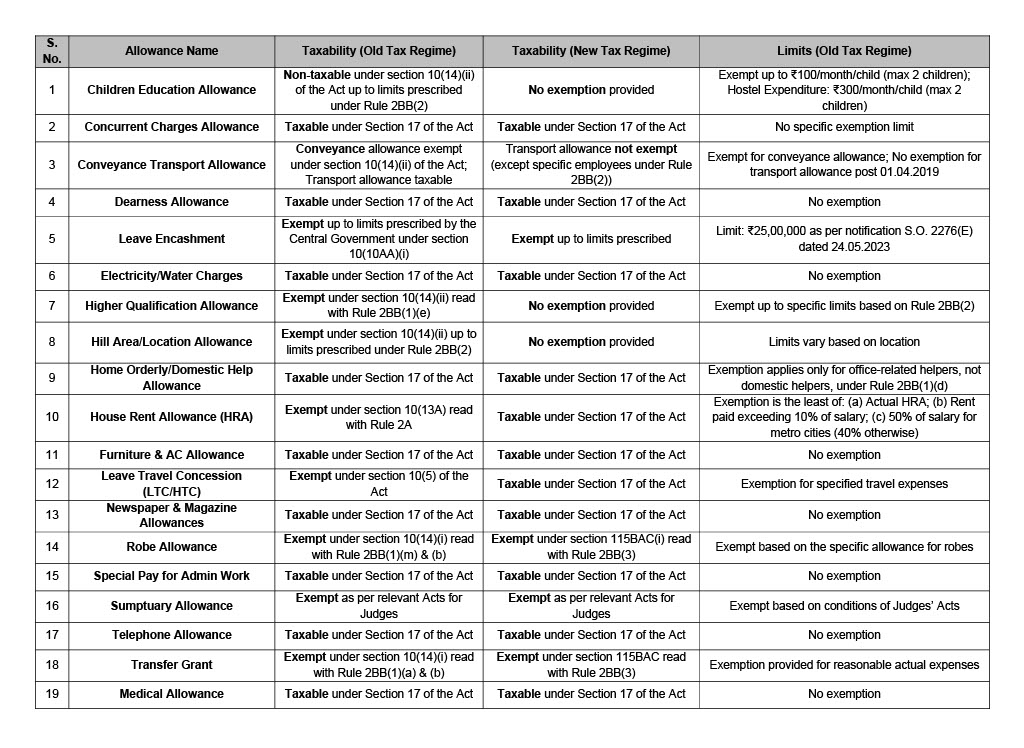
    In the meantime, the Central Board of Direct Taxes (CBDT) under the Ministry of Finance issued revised comments regarding the exemptions from TDS for allowances paid to judicial officers under the SNJPC recommendations. This was formalized through an Office Memorandum (F. No. 275/67/2024-IT(B)), dated August 6, 2024. The memorandum provides insights into the taxability of various allowances granted to judicial officers under both the Old and New Tax Regimes, as governed by the provisions of the Income-tax Act, 1961 and the Income-tax Rules, 1962.

    The memorandum is a vital resource for understanding which allowances are exempt from taxation and which may be subject to TDS. For clarity, the CBDT issued a comprehensive table outlining the taxability of allowances under both tax regimes. However, since the matter remains sub judice before the Hon’ble Supreme Court, the final determination regarding the exemptions from TDS on allowances paid to judicial officers will only be settled upon an authoritative ruling by the Court.
    F. No. 275/67/2024-IT(B)
    Revised Comments issued by CBDT vide Office Memorandum (F. No. 275/67/2024-IT(B)), dated August 6, 2024

    The ongoing deliberations reflect the government’s commitment to addressing the concerns of judicial officers and ensuring that their financial and professional needs are met in a fair and just manner. The resolution of the TDS applicability issue will undoubtedly have a lasting impact on the financial and administrative landscape of the judiciary in India.
  • Comprehensive Guide to Income Tax Deductions and Exemptions in India

    Comprehensive Guide to Income Tax Deductions and Exemptions in India

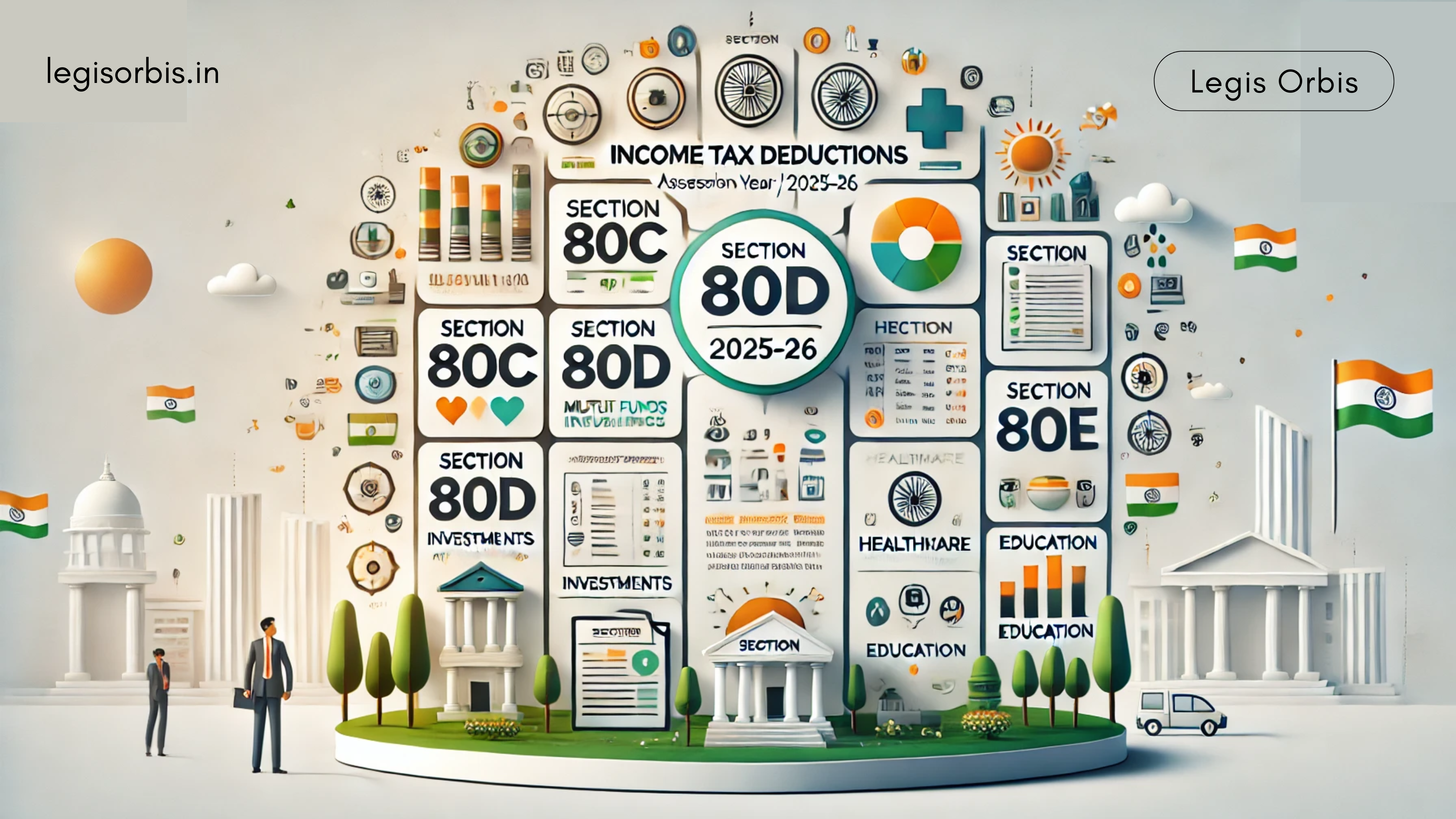
    Understanding the various income tax deductions and exemptions available under the Income Tax Act of India is crucial for taxpayers aiming to optimize their tax liabilities. Below is a detailed overview of these provisions:

    1. Section 80C: Deduction for Investments in Specified Financial Instruments

    Taxpayers can claim a deduction of up to ₹1.5 lakh for investments in the following instruments:

    • Life Insurance Premiums
    • Employee Provident Fund (EPF) Contributions
    • Public Provident Fund (PPF) Investments
    • National Savings Certificates (NSC)
    • Tax-saving Fixed Deposits with Banks
    • 5-Year Fixed Deposit with Banks
    • Senior Citizens Savings Scheme (SCSS)
    • Sukanya Samriddhi Account
    • Tuition Fees for up to two children
    • Home Loan Principal Repayment

    2. Section 80CCC: Deduction for Contributions to Pension Funds

    Contributions to pension funds of Life Insurance Corporation of India (LIC) or any other insurer qualify for a deduction under this section. The combined deduction under sections 80C, 80CCC, and 80CCD(1) is limited to ₹1.5 lakh.

    3. Section 80CCD(1): Deduction for Contributions to National Pension Scheme (NPS)

    Individuals can claim a deduction for contributions to NPS, subject to the following limits:

    • For salaried individuals: Up to 10% of salary (Basic + Dearness Allowance)
    • For self-employed individuals: Up to 20% of gross income

    This deduction is included within the overall limit of ₹1.5 lakh under sections 80C, 80CCC, and 80CCD(1).

    4. Section 80CCD(1B): Additional Deduction for NPS Contributions

    An additional deduction of up to ₹50,000 is available for contributions to NPS under this section, over and above the ₹1.5 lakh limit.

    5. Section 80CCD(2): Employer’s Contribution to NPS

    Employer contributions to an employee’s NPS account are deductible under this section. The deduction is limited to:

    • 14% of salary (Basic + Dearness Allowance) for government employees
    • 10% of salary for other employees

    This deduction is not subject to the ₹1.5 lakh limit.

    6. Section 80D: Deduction for Premiums on Health Insurance

    Deductions are available for premiums paid on health insurance policies:

    • For self, spouse, and children: Up to ₹25,000
    • For parents: Additional ₹25,000 (₹50,000 if parents are senior citizens)

    The total deduction under section 80D cannot exceed ₹1 lakh.

    7. Section 80DD: Deduction for Maintenance of Disabled Dependents

    A deduction of ₹75,000 is available for expenses incurred on the medical treatment, training, and rehabilitation of a dependent with a disability. If the disability is severe, the deduction increases to ₹1.25 lakh.

    8. Section 80DDB: Deduction for Medical Treatment of Specified Diseases

    Deductions are available for expenses incurred on the medical treatment of specified diseases:

    • For individuals below 60 years: Up to ₹40,000
    • For senior citizens: Up to ₹1 lakh

    The diseases covered include cancer, neurological diseases, and others.

    9. Section 80E: Deduction for Interest on Education Loans

    Interest paid on loans taken for higher education is deductible under this section. The deduction is available for a maximum of 8 years or until the interest is paid, whichever is earlier.

    10. Section 80EE: Deduction for Interest on Home Loan

    An additional deduction of up to ₹50,000 is available for interest paid on home loans, provided the loan amount does not exceed ₹35 lakh, and the property value does not exceed ₹50 lakh.

    11. Section 80EEA: Deduction for Interest on Home Loan for Affordable Housing

    An additional deduction of up to ₹1.5 lakh is available for interest paid on home loans for the purchase of affordable housing properties, subject to certain conditions.

    12. Section 80EEB: Deduction for Interest on Loans for Electric Vehicles

    A deduction of up to ₹1.5 lakh is available for interest paid on loans taken for the purchase of electric vehicles.

    13. Section 80G: Deduction for Donations to Charitable Institutions

    Donations to specified charitable institutions qualify for deductions under this section. The deduction amount depends on the institution and the nature of the donation.

    14. Section 80GG: Deduction for Rent Paid

    Individuals who do not receive HRA can claim a deduction for rent paid, subject to certain conditions. The maximum deduction is ₹5,000 per month or 25% of total income, whichever is less.

    15. Section 80GGA: Deduction for Donations for Scientific Research or Rural Development

    Donations made to specified institutions for scientific research or rural development are eligible for deductions under this section.

    16. Section 80GGC: Deduction for Contributions to Political Parties

    Individuals can claim a deduction for contributions made to political parties or electoral trusts under this section. The deduction is available only if the payment is made through modes other than cash. This deduction is not available to companies, local authorities, or any artificial juridical person wholly or partly funded by the government.

    17. Section 80TTA: Deduction for Interest on Savings Accounts

    Individuals can claim a deduction of up to ₹10,000 on interest income earned from savings accounts held with banks, co-operative societies, or post offices. This deduction is available only to individuals and Hindu Undivided Families (HUFs). Interest income exceeding ₹10,000 is taxable.

    18. Section 80TTB: Deduction for Interest on Deposits for Senior Citizens

    Senior citizens (aged 60 years or above) can claim a deduction of up to ₹50,000 on interest income earned from deposits with banks, co-operative societies, or post offices. This deduction is available only to senior citizens and is over and above the ₹10,000 limit under section 80TTA.

    19. Section 80U: Deduction for Individuals with Disabilities

    Individuals with a disability (as defined under the Persons with Disabilities Act) can claim a deduction of ₹75,000. If the disability is severe, the deduction increases to ₹1.25 lakh. The deduction is available to individuals with a disability certificate issued by a medical authority.

    These deductions are designed to encourage savings, investments, and support for specific causes, thereby reducing the overall tax liability of taxpayers.

  • [Opinion] Justice or a Cruel Joke?

    [Opinion] Justice or a Cruel Joke?

    The RG Kar Rape-Murder Case: A Mirror to India’s Justice Delivery System

    A Kolkata court has held Sanjoy Roy guilty of the gruesome rape and murder of a trainee doctor at RG Kar Medical College. A victory for justice? Let’s not jump the gun. The sentencing will take place soon, but a deep dive into this case unveils a disturbing gap between the ideals of ‘justice’ and the application of ‘law.’ This isn’t just another courtroom drama; it’s a painful reminder of how India’s justice system often stumbles in delivering anything close to actual justice.

    The Gruesome Crime

    The incident occurred in August 2024, shaking the conscience of the nation. A young doctor—a symbol of hope and service—brutally raped and murdered within the premises of her workplace. Public outrage followed. Protests erupted. Social media hashtags trended. Everyone demanded swift justice. Yet here we are, months later, with a singular conviction and a heap of unanswered questions.

    The case saw multiple twists and turns: the initial ‘unnatural death’ registration by the local police, the delayed transfer of investigation to the CBI, the inexplicable bail granted to co-accused due to ‘technicalities,’ and the overall snail-paced legal process. Is this what justice looks like in the world’s largest democracy?

    Justice vs. Law: The Stark Divide

    Let’s be clear: convicting Sanjoy Roy does not mean justice has been served. The law might operate within its own rigid framework, ticking boxes of procedure, but justice demands more. It’s supposed to be about fairness, accountability, and closure—none of which seem to have been fully achieved here.

    1. The Missing Accountability

    Why were the former principal and the officer-in-charge, both crucial figures in the alleged cover-up, granted bail? The CBI couldn’t file chargesheets in time. But isn’t it their job to do so? When investigative lapses allow key players to escape the clutches of the law, can we truly claim justice has been done?

    2. Delays that Kill

    The Indian justice system is infamous for its delays, and this case is no exception. By the time the wheels of justice begin to turn, public memory fades, and the emotional impact of the crime diminishes. The urgency for reform dissipates. The victim and her family? Forgotten footnotes in the annals of judicial lethargy.

    3. Selective Punishment

    What’s the point of convicting one accused while others walk free due to procedural inefficiencies? Justice is not just about punishing the guilty but ensuring that everyone complicit—directly or indirectly—faces the consequences. The system’s inability to hold all perpetrators accountable is its biggest failure.

    The Nirbhaya Parallel: When Justice Rings Hollow

    Remember the Nirbhaya case? Four men were hanged, yet has the safety of women in India improved? Justice wasn’t just about the execution of those men; it was about systemic change. Where is that change? Cases of rape and violence against women continue to flood our courts. The death penalty may satisfy a thirst for retribution, but it does little to address the root causes of such crimes.

    In both the Nirbhaya and RG Kar cases, the narrative of ‘justice served’ is deeply flawed. Justice is not about a symbolic act—it’s about real, tangible change that ensures such incidents don’t recur. Hanging four men or convicting one accused doesn’t solve the larger problem of a society and a system that repeatedly fail its women.

    A Sarcastic Look at the Justice System

    Let’s applaud the Indian justice system. Where else can an ‘unnatural death’ be upgraded to a rape-murder only after massive public outcry? Where else can the CBI, our so-called premier investigative agency, fumble in filing timely chargesheets? And where else can we call a trial ‘swift’ when it takes months—sometimes years—to reach a verdict?

    Our justice system is a well-oiled machine—if the oil is corruption, inefficiency, and apathy. It prioritizes procedure over people, form over substance. The result? A hollow semblance of justice that serves no one but the system itself.

    The Way Forward

    If we are serious about bridging the gap between justice and law, here’s what needs to change:

    1. Accountability for Investigators and Prosecutors: Ensure that delays in filing chargesheets or prosecuting cases are met with strict penalties.
    2. Judicial Reforms: Fast-track courts for heinous crimes are a start, but we need systemic changes to ensure timely and fair trials.
    3. Victim-Centric Approach: Justice isn’t about convicting someone; it’s about providing closure to victims and their families. This includes financial compensation, counseling, and social support.
    4. Societal Change: Laws alone can’t solve deep-rooted societal issues. Education, awareness, and cultural shifts are imperative.

    Conclusion

    The conviction of Sanjoy Roy might be seen as a win on paper, but in the larger scheme of things, it’s a pyrrhic victory. The gaps in investigation, the delays in justice, and the selective punishment of the guilty paint a grim picture of a system that’s more about optics than outcomes. Until we address these systemic flaws, justice in India will remain a cruel joke—one that’s as tragic as it is infuriating.

  • [Judgment Analysis] Legitimate Dissent Must Not Be Confused with Sedition

    [Judgment Analysis] Legitimate Dissent Must Not Be Confused with Sedition

    Tejender Pal Singh vs. State of Rajasthan

    2024:RJ-JD:34845

    In a significant judgment pronounced by the Rajasthan High Court, the FIR against Sikh preacher Tejender Pal Singh was quashed. The case, rooted in allegations of anti-national speech, provides critical insights into the intersection of free speech, dissent, and national integrity under Indian law.

    The Case at a Glance

    The FIR was filed following allegations that Tejender Pal Singh, through a Facebook video, expressed sympathy for Amritpal Singh, a Member of Parliament, while also purportedly advocating Khalistan. The complainant claimed the speech endangered India’s unity and integrity, citing sections 152 and 197(1)(c) of the Bhartiya Nyaya Sanhita (BNS), 2023.

    Tejender Pal Singh contended that the FIR was a result of personal vendetta, fueled by rivalries among Sikh religious factions. His defense argued that the content of the video did not incite rebellion or separatism and fell within the ambit of lawful criticism.

    Legal Framework and Court’s Observations

    The prosecution invoked:

    • Section 152, BNS: Penalizing acts that endanger India’s unity and integrity.
    • Section 197(1)(c), BNS: Addressing assertions likely to cause disharmony between religious or communal groups.

    The court, however, emphasized the need for a high threshold of intent (mens rea) for these provisions to apply. Justice Arun Monga highlighted that:

    1. Free Speech vs. Sedition: The judgment underscored that lawful dissent and critique of government measures do not amount to sedition or anti-national acts.
    2. Mens Rea as a Requirement: The court ruled that casual or rhetorical statements do not constitute offenses unless they directly incite rebellion or public disorder.
    3. Importance of Context: The video content, though controversial, did not explicitly advocate rebellion or separatist activities.

    Citing precedents like Balwant Singh v. State of Punjab and Kedar Nath Singh v. State of Bihar, the court noted that dissent must not be stifled under the guise of national security.

    Key Findings

    The court dissected the alleged statements in the video, including phrases like “Khalistan slogans in Parliament” and “fear of Khalsa.” It concluded that these did not fulfill the criteria for sedition or actions undermining sovereignty. Instead, the remarks were viewed as expressions of community pride and critique of perceived government actions.

    The court also observed the complainant’s history of filing multiple FIRs against the petitioner, some of which had already been dismissed. This led to a strong inference of personal malice.

    Judicial Precedents and Implications

    The judgment draws attention to the newly enacted BNS, which replaces the Indian Penal Code (IPC). While section 152 under BNS reintroduces elements of sedition, the court noted the importance of not allowing the provision to suppress democratic freedoms.

    The ruling also establishes a precedent for interpreting speech-related offenses in the digital age. Social media, often a space for polarizing content, must not become a tool to curb legitimate dissent.

    Broader Significance

    This decision serves as a reminder of the judiciary’s role in safeguarding constitutional rights while ensuring the legal framework supports national unity. It reinforces the importance of distinguishing between lawful critique and malicious propaganda.

    Conclusion

    The Rajasthan High Court’s judgment in this case reaffirms India’s commitment to democratic values and freedom of expression. It cautions against the misuse of legal provisions to settle personal scores or suppress dissent. As new laws like the BNS take effect, the judgment sets a critical benchmark for balancing individual rights with national interests.

  • [Judgment Analysis] High Courts Can Quash Criminal Proceedings Invoking Article 226 Jurisdiction: Supreme Court

    [Judgment Analysis] High Courts Can Quash Criminal Proceedings Invoking Article 226 Jurisdiction: Supreme Court

    Kim Wansoo v. State of Uttar Pradesh & Ors., 2025 INSC 8

    In a landmark decision (Kim Wansoo v. State of Uttar Pradesh & Ors., 2025 INSC 8), the Supreme Court of India reaffirmed that High Courts possess the authority to quash criminal proceedings not only under Section 482 of the Cr.P.C. but also by invoking their extraordinary jurisdiction under Article 226 of the Constitution of India. This judgment solidifies the expansive powers of High Courts in ensuring justice and preventing the misuse of legal mechanisms.

    Case Background
    The appellant, a foreign national and Project Manager of Hyundai Engineering & Construction India LLP (HEC India LLP), was implicated in a First Information Report (FIR) filed under various sections of the Indian Penal Code (IPC). The FIR alleged financial fraud and misappropriation of funds amounting to ₹9 crores in a subcontracting dispute. The Allahabad High Court had refused to quash the FIR, leading to the appellant's appeal before the Supreme Court.

    Key Observations by the Supreme Court

    1. Scope of Article 226 and Section 482
      The Court clarified that while Section 482 of the Cr.P.C. is commonly invoked for quashing criminal proceedings, the extraordinary jurisdiction under Article 226 of the Constitution is equally available for this purpose. Relying on precedents such as State of Haryana v. Bhajan Lal and Pepsi Foods Ltd. v. Special Judicial Magistrate, the Court emphasized that these powers should be exercised to prevent the abuse of legal processes or to secure the ends of justice.
    2. Categories Warranting Quashing
      Drawing from the Bhajan Lal judgment, the Court reiterated the illustrative circumstances under which criminal proceedings can be quashed. These include:
      • Allegations that do not disclose a prima facie offense.
      • Absurd or inherently improbable allegations.
      • Malicious prosecutions intended to harass or settle personal scores.
    3. Judicial Vigilance
      The judgment underlined the importance of judicial intervention in cases where an FIR or complaint lacks substantive merit. The Court observed that vague or unsupported allegations cannot justify prolonged litigation, which would otherwise cause undue harassment to the accused.

    Decision and Rationale
    The Supreme Court found the allegations in the FIR against the appellant to be vague and unsupported by concrete evidence. It noted that the FIR primarily targeted other parties in the subcontracting chain, and the appellant was unfairly implicated. Highlighting the potential abuse of the legal process, the Court held that allowing the appellant to face trial would result in a miscarriage of justice.

    Consequently, the Court set aside the Allahabad High Court’s refusal to quash the FIR and quashed all proceedings against the appellant.


    Significance of the Judgment

    1. Expanding the Reach of Article 226
      This ruling underscores the flexibility of Article 226 jurisdiction, which allows High Courts to address grievances arising from the misuse of criminal law. It affirms that these powers are complementary to those under Section 482 of the Cr.P.C. and are not mutually exclusive.
    2. Balancing Justice and Fairness
      By exercising its quashing powers, the Supreme Court reaffirmed its commitment to safeguarding individuals against baseless criminal proceedings. The judgment reiterates that the judiciary must act as a guardian against procedural overreach.
    3. Curbing Civil Disputes Masquerading as Criminal Cases
      The case highlights the misuse of criminal law to enforce civil liabilities—a trend increasingly observed in contractual disputes. The judgment serves as a cautionary reminder to litigants against weaponizing criminal proceedings for ulterior motives.

    Conclusion
    The Supreme Court’s decision in Kim Wansoo reiterates the expansive jurisdiction of High Courts under Article 226 and Section 482 Cr.P.C. to prevent the misuse of the criminal justice system. It strengthens judicial intervention in cases of frivolous or malicious prosecutions, ensuring that justice prevails and procedural safeguards are upheld.

  • [Opinion] Why Justice Nagarathna’s Call for Judges to Refrain from Social Media Is a Step Toward Upholding Judicial Integrity

    [Opinion] Why Justice Nagarathna’s Call for Judges to Refrain from Social Media Is a Step Toward Upholding Judicial Integrity

    The observations by Justice BV Nagarathna emphasizing that judges should refrain from using social media, especially to comment on judgments, are a timely reminder of the critical need to preserve judicial impartiality. Justice is not only about fair decision-making but also about maintaining public confidence in the judiciary’s independence and objectivity.

    Judges expressing opinions on judgments on platforms like Facebook risk undermining this trust. Such actions may suggest a predetermined mindset, jeopardizing their ability to adjudicate impartially in future cases. This not only impacts the perception of fairness but can also adversely affect the rights of parties, particularly if the opinions relate to ongoing or contentious matters.

    Judicial officers are entrusted with a unique responsibility that demands exceptional restraint and discretion. By avoiding social media commentary, judges uphold the principle that justice must not only be done but also be seen to be done. As Justice Nagarathna aptly pointed out, judges who accept their role must embrace the sacrifices it entails, including refraining from actions that may compromise the dignity of their office. This guidance serves to reinforce the judiciary’s role as a bastion of fairness and integrity in a rapidly changing digital landscape.