Supreme Court of India Durga Prasad v. Government of NCT of Delhi & Ors. Civil Appeal arising out of SLP (C) No. 2111 of 2023 Date of Judgment: 23.04.2025 Neutral Citation: 2025 INSC 548
Ratio: Remand for fresh disciplinary proceedings may be declined where long delay makes it harsh, unfair, or unnecessary.
DEPARTMENTAL PROCEEDINGS – Disagreement with inquiry report – Scope of remand – Delay and prejudice – Civil appeal filed by the appellant, a retired police officer, challenging the High Court’s order granting liberty to the disciplinary authority to issue a fresh disagreement note after setting aside the penalty imposed on him. The appellant was proceeded against for alleged lapses during the 1984 riots; the Inquiry Officer exonerated him, but the Disciplinary Authority disagreed and imposed punishment. The High Court set aside the punishment holding the disagreement note to be defective, but granted liberty to proceed afresh. Held, though ordinarily matters may be remanded where procedural infirmities are found, remand is not mandatory and may be declined where a long time-lag renders it harsh or unnecessary. Considering that the incident was over four decades old, the appellant had long since demitted office, and the disagreement note was cryptic and ignored material findings of the Inquiry Officer, permitting a fresh exercise would be wholly unfair. Liberty granted by the High Court to issue a fresh disagreement note set aside. Appellant held entitled to all consequential benefits including revision of pension. Civil appeal allowed.
Rajasthan High Court Satya Narain v. The Judge, Central Industrial Tribunal, Kota & Anr. S.B. Civil Writ Petition No. 14013 of 2011 Date of Judgment: 06.01.2026 Neutral Citation: 2026:RJ-JP:191
Ratio: Reinstatement is not automatic for illegal retrenchment of daily-wage workers; monetary compensation may be granted instead.
INDUSTRIAL DISPUTE – Illegal retrenchment – Daily-wage workman – Section 25F of the Industrial Disputes Act, 1947 – Reinstatement vs. monetary compensation – Scope of interference under Articles 226 and 227 of the Constitution of India – Writ petition filed by the workman challenging the award of the Labour Court, Kota, holding termination to be in violation of Section 25F of the Industrial Disputes Act, 1947, but granting lump-sum compensation in lieu of reinstatement. Held, violation of Section 25F renders retrenchment illegal; however, reinstatement is not an automatic consequence, particularly in the case of daily-wage employees engaged for a short duration without regular selection process. Considering the limited tenure of service, absence of mala fides, and long lapse of time since termination, monetary compensation was held to be a just and equitable substitute for reinstatement. Award modified by enhancing compensation. Writ petition disposed of.
Bombay High Court Apsara Co-operative Housing Society Ltd. v. Vijay Shankar Singh Writ Petition Nos. 3908 of 2025 and 4146 of 2025 Date of Judgment: 05.01.2026 Neutral Citation: 2026:BHC-OS:41
Ratio: A co-operative housing society formed for residential management is neither an “industry” nor an “establishment”; labour and gratuity laws are inapplicable.
INDUSTRIAL DISPUTE / PAYMENT OF GRATUITY – Co-operative housing society – Status as ‘industry’ and ‘establishment’ – Sections 2(j) and 33-C(2) of the Industrial Disputes Act, 1947 – Section 1(3) of the Payment of Gratuity Act, 1972 – Section 2(4) of the Maharashtra Shops and Establishments Act, 2017 – Writ petitions filed by the petitioner-Society challenging orders of the Labour Court and the Controlling Authority entertaining proceedings under the Industrial Disputes Act, 1947 and the Payment of Gratuity Act, 1972. Held, a co-operative housing society formed by flat owners for collective ownership and maintenance of residential premises does not carry on any trade, business, or commercial activity and is neither an “industry” nor an “establishment.” Incidental income from telecommunication towers or use of common facilities does not alter the dominant non-commercial character of the society. Authorities under the Industrial Disputes Act and the Payment of Gratuity Act lacked jurisdiction to entertain the proceedings. Impugned orders set aside. Writ petitions allowed.
Bombay High Court Bank of Baroda v. Shri Shashikant Pitale & Ors. Writ Petition No. 3063 of 2014 Date of Judgment: 12.12.2025 Neutral Citation: 2025:BHC-OS:24539
Ratio: Industrial tribunals cannot direct regularisation or reinstatement beyond the scope of reference; compensation may substitute reinstatement for daily wagers.
INDUSTRIAL DISPUTE – Illegal termination – Casual/daily-wage workmen – Sections 25F and 25G of the Industrial Disputes Act, 1947 – Reinstatement and regularisation – Scope of reference – Writ petition filed by the Bank challenging the Award of the Central Government Industrial Tribunal-II, Mumbai, holding termination of respondent daily-wage peons illegal and directing reinstatement with back wages and regularisation. Held, findings of violation of Sections 25F and 25G did not call for interference. However, reinstatement is not automatic for daily-wage workers after long lapse of time; lump-sum compensation is the appropriate relief. Further held, the Tribunal exceeded its jurisdiction in directing regularisation, the issue being beyond the scope of reference and contrary to settled law, including Umadevi (2006) 4 SCC 1. Award modified by setting aside reinstatement, back wages, and regularisation and substituting lump-sum compensation. Writ petition partly allowed.
“Learn | Innovate | Lead — Hands-On Experience at UIDAI”
🎯 Core Highlights
✔️ Internship opportunity with Unique Identification Authority of India (UIDAI) ✔️ Gain real-world experience in Tech & Digital Identity Projects ✔️ Work with leading digital governance teams ✔️ Open to eligible students seeking hands-on exposure ✔️ Boost your career prospects in tech & public sector 🚀
Details
The Internship Scheme by the Unique Identification Authority of India (UIDAI) enables the students to gain adequate exposure to various Technology tracks and other units within UIDAI Headquarters, Technology Centre and Regional offices. It would be expected to work in the field of application development, legal domains (like cyber laws/IT act) & general management. For the “Interns” the exposure to the functioning of the UIDAI & the technologies applied shall be an add-on furthering their future career prospects in niche technology, legal domains, management and many other areas as the case may be.
Benefits
Stipend (in ₹ per Month)
1. Technical
B.Tech. (Premises): 30,000; (Remote): 15,000
M.Tech. (Premises): 40,000; (Remote): 20,000
MBA (Premises): NA; MBA (Remote): NA
Other relevant fields like Economics and Law (Premises): NA
Other relevant fields like Economics and Law (Remote): NA
PhD (Premises): 50,000; PhD (Remote): 25,000
2. Professional
B.Tech. (Premises): NA; (Remote): NA
M.Tech. (Premises): NA; (Remote): NA
MBA (Premises): 40,000; MBA (Remote): 20,000
Other relevant fields like Economics and Law (Premises): NA
Other relevant fields like Economics and Law (Remote): NA
PhD (Premises): NA; PhD (Remote): NA
3. Non-Technical
B.Tech. (Premises): NA; (Remote): NA
M.Tech. (Premises): NA; (Remote): NA
MBA (Premises): NA; MBA (Remote): NA
UG in Other relevant fields like Economics and Law (Premises): 20,000
PG in Other relevant fields like Economics and Law (Premises): 30,000
UG in Other relevant fields like Economics and Law (Remote): 10,000
PG in Other relevant fields like Economics and Law (Remote): 15,000
PhD (Premises): NA; PhD (Remote): NA
Logistic Support
The basic lodging facilities can be made available on a payment basis in UIDAI Technology Centre, only.
The intern may be given access to the office internet, which shall be at the sole discretion of the supervising officer and subject to compliance with the Information Security Policy of UIDAI.
NOTE 1: The Intern has to make his/her own accommodation arrangement during the internship in case of working from UIDAI premises.
NOTE 2: They shall arrange their own transport to and from the office.
NOTE 3: The Intern will not be given any Computer System/Laptop etc for carrying out his/her assignments during the internship.
NOTE 4: The intern shall be required to bring his/her own Laptop for carrying out the work assigned to him/her.
Experience Certificate
The UIDAI will issue a certificate for the period of internship in UIDAI at the end of the internship subject to the completion of assigned work, duly recommended by the concerned reporting officer.
Eligibility
For Internship
1. The applicant should be a citizen of India.
2. The applicant should be a bonafide student of any recognized University/ Institution within India or abroad.
3. The applicant should fulfil ANY ONE of the following conditions:
A) The applicant should be studying in the 3rd / 4th year (Final or pre-final) in B.Tech / BE course of any discipline and secured a minimum of 60% marks (GPA avg of 6.0) in all prior semester examinations.
B) The applicant should be a graduate student having completed/ appeared in the term-end exams of the 1st year/2nd semester of their post-graduate programme or pursuing research/ PhD and secured not less than 60% or equivalent marks in Graduation.
C) The students who have appeared in the final exam or just completed Graduation/PG and waiting for admission to higher studies or job may also be considered for internship provided that they fulfil the following conditions –
C1) They have secured 60 % or more cumulative marks in all the years/semesters of their graduation/ post-graduation till the date of application.
C2) The period between the month of declaration of the result of the final exam and the desired month of the internship should not exceed six months.
For Fellowship
1. The student must be registered for a PhD at an Indian institution.
2. These fellowships are for six to nine months (extendable to 12 months) on Computer Science (Including, but Not Limited to It Act and Cyber Laws Related to Data Privacy, Cyber Security, Digital Economy, Block Chain, Quantum Computing, Computer Vision, Artificial Intelligence, Machine Learning and Big Data Analytics) and on Public Policy and Management.
Application Process
Online
Interested and eligible students need to Email their duly filled and signed application form in the prescribed format, along with the required (self-attested) documents to webadmin-uidai@nic.in.
NOTE: Candidates applying for a 1-year Internship should apply within 6 months from the completion of the final exam.
Offline
Till the facility online application is in place, the prospective candidates may apply to UIDAI ROs/ Technology Centre/ Divisions of HQ in the prescribed form as per Annexure-X (containing the Designation of DD Concerned and postal address).
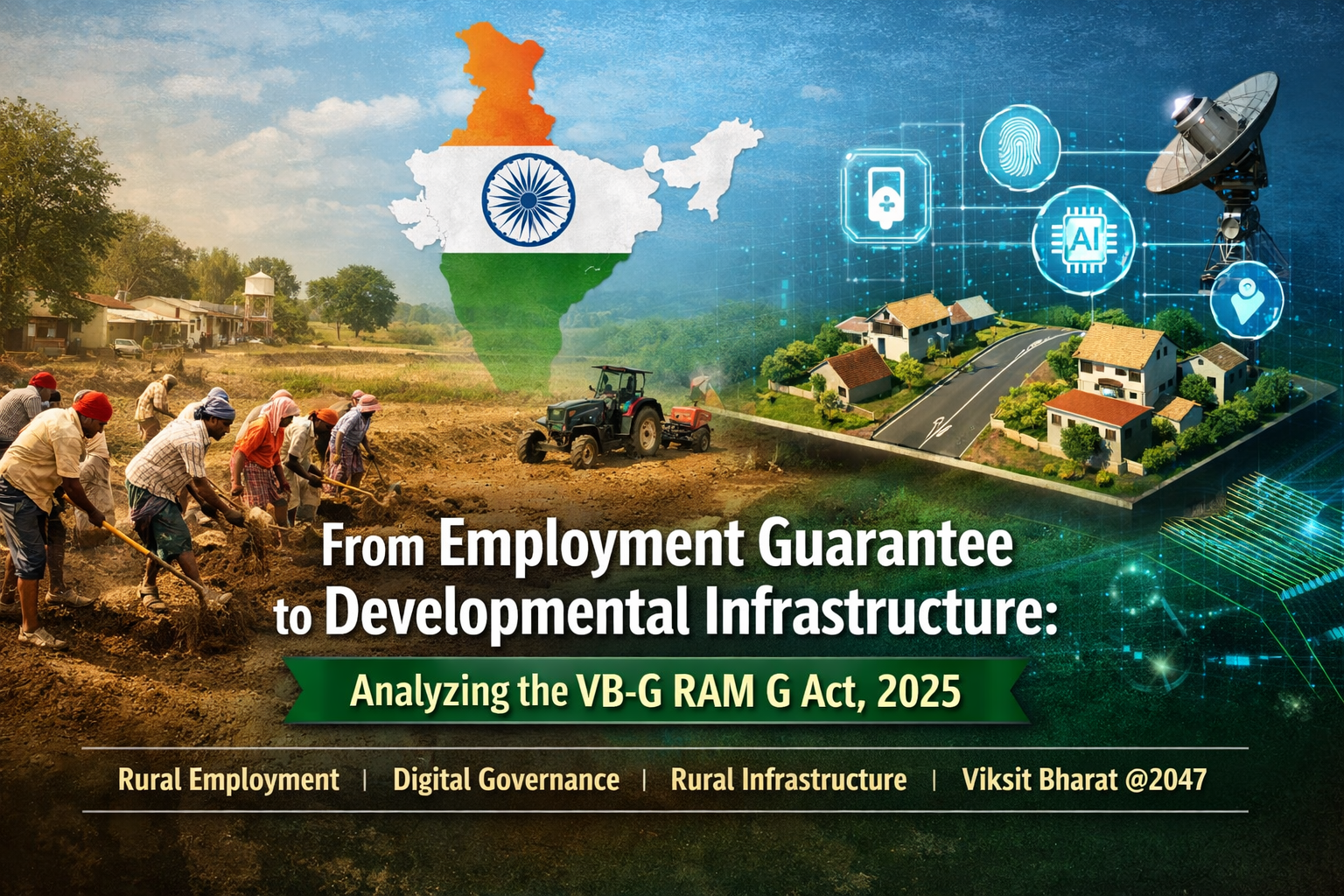
The Viksit Bharat – Guarantee for Rozgar and Ajeevika Mission (Gramin) Act, 2025 represents a decisive shift in India’s rural employment jurisprudence. Repealing the Mahatma Gandhi National Rural Employment Guarantee Act, 2005, the new enactment expands the statutory employment guarantee to one hundred and twenty-five days while embedding rural wage employment within a national infrastructure, convergence, and saturation-driven planning framework aligned with the vision of Viksit Bharat @2047. This article critically examines the Act’s legislative design, constitutional positioning, decentralisation framework, fiscal federalism implications, and technology-centric accountability architecture. It argues that the Act marks a transition from a rights-based social welfare statute to a development-oriented rural infrastructure mission, raising important concerns regarding conditionality of entitlements, centralisation of planning, digital exclusion, and dilution of grassroots accountability mechanisms.
Keywords: Rural employment guarantee; VB–G RAM G Act, 2025; MGNREGA; decentralisation; fiscal federalism; digital governance; Viksit Bharat.
I. Introduction
Since its enactment in 2005, the Mahatma Gandhi National Rural Employment Guarantee Act (MGNREGA) stood as a rare example of a justiciable socio-economic right in Indian statutory law. The enactment of the Viksit Bharat – Guarantee for Rozgar and Ajeevika Mission (Gramin) Act, 2025 (VB–G RAM G Act) repeals this framework and replaces it with a more expansive yet structurally different rural employment regime. While the new Act enhances the guaranteed days of employment and integrates climate resilience and infrastructure creation, it also reorients rural employment away from a purely rights-based paradigm toward a mission-mode developmental architecture.
This paper undertakes a doctrinal and structural analysis of the VB–G RAM G Act, situating it within constitutional principles of social justice, decentralisation, and federalism, and critically comparing it with the repealed MGNREGA framework.
II. Legislative Objectives and Policy Orientation
The VB–G RAM G Act expressly aligns rural employment with the national vision of Viksit Bharat @2047. Unlike MGNREGA, which was primarily conceived as a livelihood security measure, the new Act articulates multiple policy objectives: enhanced wage employment, aggregation of public works into a National Rural Infrastructure Stack, convergence with other development schemes, and climate adaptation through infrastructure creation.
This explicit developmental orientation reflects a shift in legislative philosophy—from employment as an end in itself to employment as a means for long-term asset creation and rural transformation.
III. Employment Guarantee and Conditionality
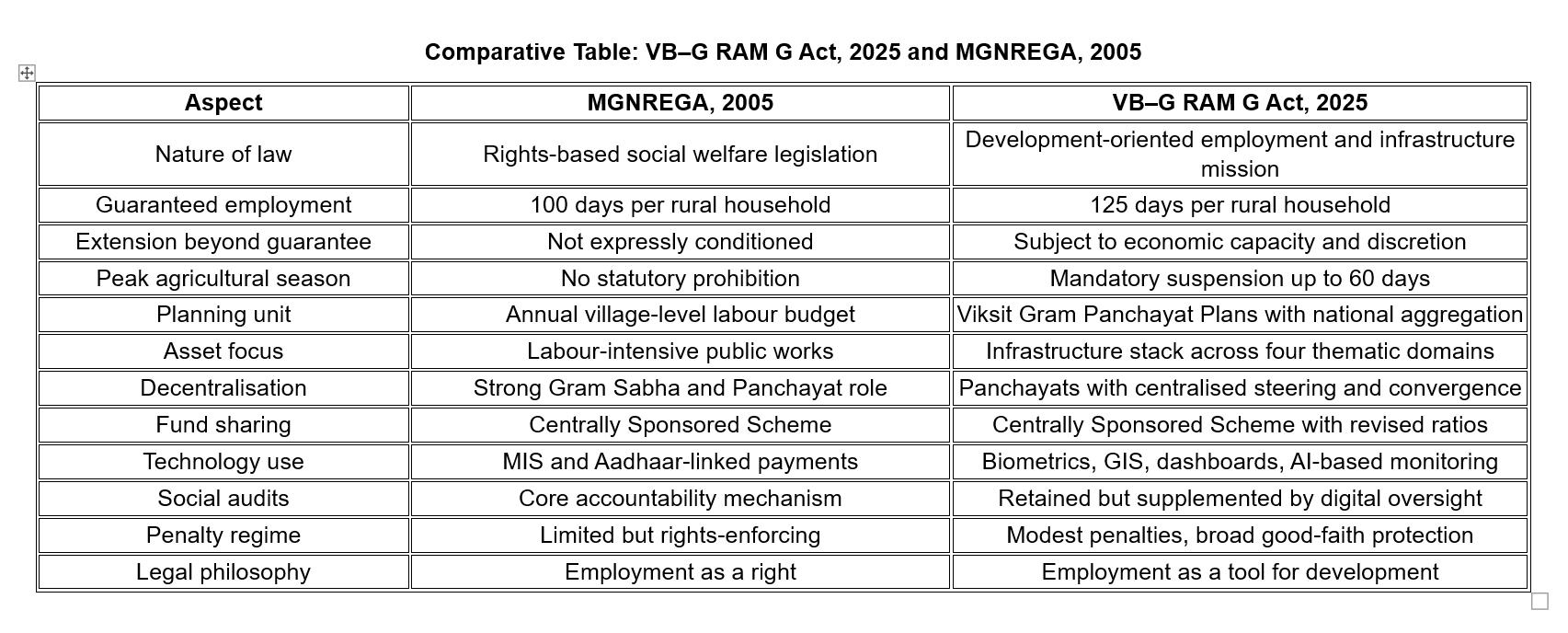
Section 5 of the VB–G RAM G Act increases the statutory guarantee to one hundred and twenty-five days per rural household per financial year. However, the Act introduces explicit conditionality by permitting extension beyond the guaranteed period only within the limits of economic capacity and development. Further, Section 6 statutorily prohibits execution of works during notified peak agricultural seasons, effectively suspending the employment guarantee for up to sixty days annually.
This represents a departure from the on-demand character of MGNREGA and signals a recalibration of the balance between labour welfare and agricultural productivity.
IV. Planning Architecture and Decentralisation
While Panchayats continue to be designated as principal authorities for planning and implementation, the VB–G RAM G Act introduces a multi-layered planning architecture anchored in Viksit Gram Panchayat Plans and aggregated upward into State and National infrastructure stacks. Mandatory integration with PM Gati Shakti and geospatial platforms significantly constrains local discretion.
Although participatory planning is formally retained, substantive decentralisation is diluted by strong central steering committees, normative allocations, and binding national priorities, raising concerns under Part IX of the Constitution.
V. Fiscal Federalism and Fund Sharing
The Act retains the Centrally Sponsored Scheme model with revised fund-sharing ratios. Normative allocation powers are vested in the Central Government, and States bear liability for unemployment allowance and excess expenditure. This fiscal design strengthens vertical control of the Union and may disproportionately burden fiscally weaker States, thereby affecting uniform realisation of employment guarantees.
VI. Technology, Transparency, and Rights Implications
The Act mandates biometric authentication, geo-tagging, real-time dashboards, and artificial intelligence-enabled monitoring. While these mechanisms enhance transparency and efficiency, the absence of statutory safeguards against technology-induced exclusion is a critical omission. Authentication failures, connectivity gaps, and data governance concerns pose risks to vulnerable rural workers, particularly women, elderly persons, and migrant households.
VII. Accountability Framework
Accountability under the VB–G RAM G Act relies heavily on technocratic oversight and digital audits, supplemented by social audits conducted by Gram Sabhas. The penalty regime is modest, and broad protection for actions taken in good faith may weaken deterrence against administrative lapses. Compared to MGNREGA’s emphasis on community vigilance, the new framework privileges managerial compliance.
VIII. Repeal of MGNREGA: Continuity and Departure
Section 37 repeals MGNREGA while providing transitional continuity. Substantively, however, the repeal marks a normative shift away from employment as a justiciable right toward employment as a component of national development strategy. The transformation reflects evolving state priorities but risks undermining the rights-based legacy of rural employment law in India.
IX. Conclusion
The VB–G RAM G Act, 2025 is an ambitious and forward-looking statute that integrates rural employment with infrastructure creation, climate resilience, and digital governance. However, its centralised planning architecture, conditional employment guarantees, and technology-heavy compliance mechanisms raise significant constitutional and socio-legal concerns. The long-term legitimacy of the Act will depend on whether it can balance efficiency with equity and preserve the substantive right to work for India’s rural poor.
![[Internship] Scheme By The Unique Identification Authority Of India (UIDAI)](https://legisorbis.in/wp-content/uploads/2026/01/7be14548-b606-4d4e-bed9-cdf36482676d.png)